Gemba Walk - A Practical guide
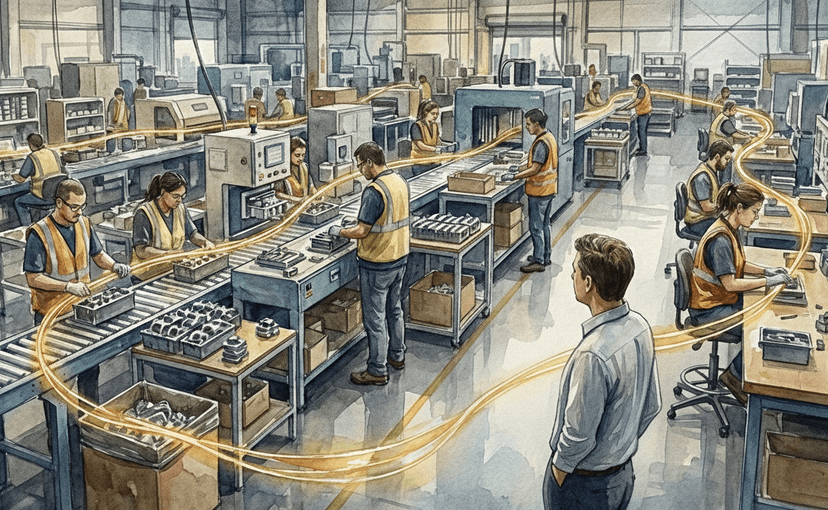
How to Carry Out a Gemba Walk
Over the past weeks, people following this space have asked:
- “How do you actually go about a Gemba Walk?”
- “What should you do when you’re out there?”
This article breaks the process down into practical, actionable steps - the kind you can apply tomorrow.
I’ll be honest: I had to sit down and consciously unpack this. It’s like being asked, “What’s 2 + 2?” - the answer comes before the thought - which is only a positive thing! After a few runs a Gemba Walk will become second nature.
But for leaders developing their practice, it’s worth slowing down and making the implicit explicit.
As managers, we cannot be everywhere at once - but we must understand what is happening where. Different organisations and practitioners have their own approaches to Gemba Walks. I’m not claiming mine is the only way, but it’s a reliable, people-centred method that has served me well.
Step 1 - Make a Plan
Unless you have infinite time, you cannot observe everything. So start with intent:
- What is the purpose of today’s Gemba Walk?
- Which area will you focus on?
- Is this a general review or a walk aimed at a specific problem?
A clear purpose prevents a “wander around and hope for insight” approach.
Step 2 - Make Sure People Are Aware
Once you know your intent, ensure the team knows a Gemba Walk is happening.
- Are you walking alone?
- Is another leader joining you?
If people are not used to Gemba Walks, your sudden appearance can create mistrust. Your intent is not to police or interrogate - it is to observe and learn.
Over the years, I’ve had operators say: “We haven’t seen you this week - I had something I wanted to show you.”. That’s trust. That’s when people want you to see what they see.
Step 3 - Walk Upstream or Downstream
There are two schools of thought:
- Walk with the value stream
- Walk against the value stream
There is no universal right answer.
My preference is to walk against the flow first - it helps reveal why problems occur. Walking with the flow helps you understand how they occur. Use both perspectives over time.
Step 4 - Observe Without Judgement
If you’ve followed the theme of “We listen and we don’t judge,” a Gemba Walk is similar:
We observe and we don’t judge.
Approach with childlike curiosity:
- “What happens here?”
- “Why is it done this way?”
- “What’s the sequence?”
- “What instructions are you following?”
- “What happens next?”
Remember: There are things happening on the shopfloor that you do not know - but you are responsible for improving them. Open questions build trust. Defensive questions shut people down. You are in learning mode, not fixing mode. Solutions come later.
Step 5 - Observe Processes and Systems, Not People
It’s natural to watch what a person is doing and mentally judge their performance. Avoid this. A Gemba Walk is not an audit of individuals. When people feel observed, they slow down, tense up, or change behaviour.
Instead, observe:
- Workflow
- Rhythm
- Movements
- Layout
- Pauses
- Handovers
- Details
If you need to time a task, that’s a separate exercise, not a Gemba Walk.
Step 6 - Take Mental or Written Notes
Photos and notes are useful; but context matters. If you take photos, explain why.
You’re not gathering evidence; you’re capturing learning. I often take notes after the walk. Walking around with a clipboard or phone can feel like a parking warden issuing tickets.
Notes help you compare observations over time and track improvements.
Step 7 - Do Not Give Immediate Feedback
This is one of the hardest disciplines. If you comment during the walk, it can feel like you arrived with the intention to correct something. Hold your thoughts. You’re still learning. You don’t yet have the full picture. Save the discussion for later - when you can reflect, verify, and collaborate.
Step 8 - Review and Follow Up
A Gemba Walk only works if you close the loop. You walked. You observed. Now what?
Discuss with the team:
- What opportunities did you see?
- What should be praised?
- What needs to be improved?
- What did the team notice?
- Are there signs of Muda, Mura, or Muri?
- How does this walk compare to previous ones?
Transparency builds trust. Follow-up builds credibility.
Step 9 - Be Consistent
A Gemba Walk done once a quarter to tick a metric is pointless.
Consistency:
- Builds trust
- Creates rhythm
- Reinforces discipline
- Enables continuous improvement
- Strengthens the value stream
Gemba Walks are not events - they are habits.
A Simple Gemba Walk Checklist
Every organisation is different, but this checklist is a solid starting point:
- Can the work process be described simply?
- Which steps add value, and which do not?
- Is there a clear flow?
- Is the process documented?
- Do different people perform the task differently? Why?
- How does the actual process differ from the SOP?
- What prevents the process from meeting target?
- What happens when a problem is identified?
- Can operators clearly identify a good part vs a bad part?
- Are employees aware of the correct process?
- Do people have concerns about the process?
- What improvement suggestions come from the team?